

The Climate Diagnostics, Air Quality and AI Lab (CDAI) Lab at KNUST is contributing to critical global conversations on the future of artificial intelligence (AI) in higher education through its RetAIn (Revolutionizing Tertiary Education for Africa's Thriving AI Economy and Workforce) project. As AI continues to reshape industries and educational systems worldwide, African higher education institutions face unique challenges related to access, inclusion, and policy readiness. The RetAIn project responds to these challenges by advancing research and advocacy focused on ensuring that AI development and adoption in Africa are equitable, inclusive, and contextually relevant.
A key output of this effort is the Lab’s contribution to the book Degrees of Change: What AI Means for Education and the Next Generation, a significant body of work exploring the transformative impact of AI on education globally. Chapter 8 of the book, titled “Rethinking AI Accessibility in African Higher Education Institutions Through Inclusive Participation and Policy Reform,” was co-authored by the CDAI Lab Lead, Dr. Jeffrey Nii Armah Aryee, alongside other members of the research team. This chapter addresses critical gaps in AI accessibility across African institutions, particularly the disparities affecting marginalized groups, and highlights the need for inclusive participation and responsive policy frameworks. A copy of the book has been donated to the College of Science Library at KNUST, where it is available for reading. Additional copies can also be purchased on Amazon.
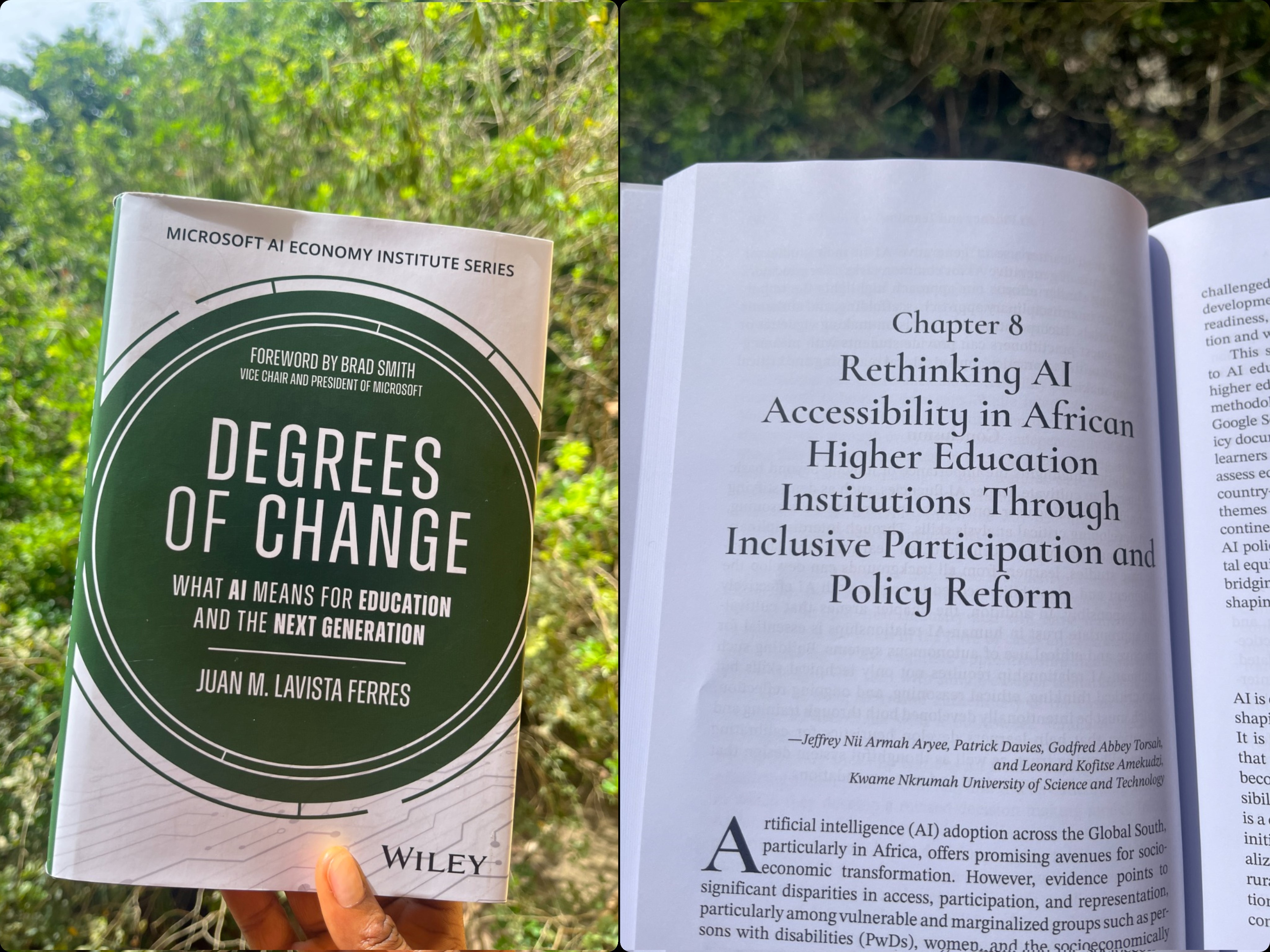
The RetAIn project adopts a forward-looking and socially responsive approach, emphasizing research-driven insights, stakeholder engagement, and policy-oriented dialogue. By interrogating existing barriers to AI adoption such as limited infrastructure, unequal access, and insufficient policy direction, the project proposes strategies that align technological advancement with social inclusion. Its contribution to the book reflects a methodological innovation that bridges academic research with real-world policy and institutional reform, positioning African universities to better participate in the global AI ecosystem.
Through this work, the CDAI Lab is not only generating knowledge but also influencing how institutions think about AI integration in teaching, learning, and workforce development. The chapter contributes to a growing body of evidence advocating for reforms that prioritize inclusivity, accessibility, and sustainability in AI-driven education systems. In doing so, it supports broader national and global priorities, including digital transformation, equitable education, and the development of a future-ready workforce.
The CDAI Lab’s involvement in this publication underscores its commitment to impactful research and collaborative engagement. By contributing to a globally recognized volume and advancing the objectives of the RetAIn project, the team is helping to shape the future of AI in higher education, ensuring that Africa is not only a participant but a key voice in defining that future.